About Cats: Nature, Behavior, and Care
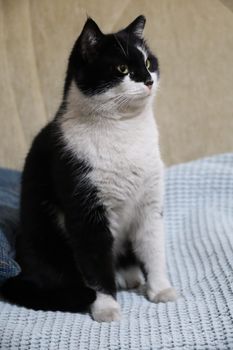
A Hunter That Chose Us
The domestic cat descends from the Near Eastern wildcat, a solitary, territorial hunter that ranged across the Middle East and North Africa. Roughly ten thousand years ago, as humans settled into farming villages, stored grain attracted rodents—and rodents attracted wildcats. Those that tolerated human proximity gained an easy food supply, and over generations a self-selected population of bolder, less fearful cats formed the species we live with today.
What makes cats unusual is how little domestication changed them. Genetically, the house cat remains close to its wild ancestor. It has the same teeth, the same digestive tract built for meat, and the same hunting sequence. A pet cat dozing on a sofa is, biologically, a highly competent predator that has simply outsourced its hunting to a bowl.
The Senses of a Predator
Understanding a cat begins with understanding what it perceives, which differs sharply from what we perceive.
Vision. Cats see well in dim light thanks to a reflective layer behind the retina and a high concentration of rod cells, but their color vision is muted compared with ours—mainly blues and greens. They are also strikingly nearsighted: anything closer than about a foot is blurry, which is why a cat may bat at a treat with a paw rather than simply look at it. Motion detection, however, is superb.
Hearing. A cat hears from roughly 48 Hz up to 85 kHz, far beyond the human ceiling of about 20 kHz. That high-frequency range overlaps with the ultrasonic squeaks of rodents, making a cat's hearing an exquisitely tuned hunting instrument.
Smell and taste. Cats have around 200 million scent receptors—roughly forty times a human's—plus a special organ in the roof of the mouth called the vomeronasal organ, used to analyze pheromones. Cats cannot taste sweetness at all, which explains their indifference to sugar.
Touch. The whiskers are precision instruments, sensitive enough to detect air currents and measure whether a gap will fit the body. Whiskers on the legs help a cat feel prey it has pinned.
Instinct in a Domestic Setting
Several behaviors that puzzle owners make sense once you see them as hunting adaptations.
- Crepuscular activity. Cats are most active at dawn and dusk—the same hours their prey moves. A cat racing around at 5 a.m. is following its biological clock.
- Burying waste. In the wild, covering droppings hides a cat's scent from larger predators. It is a survival behavior, not a sign of tidiness.
- Scratching. Claw marks serve two purposes: they visually mark territory and leave scent from glands in the paws.
- Ambush hunting. Cats stalk and rush over short distances. They are sprinters, not endurance runners, which is why short, intense play sessions satisfy them better than long, gentle ones.
- The gift of prey. A cat bringing home a mouse—or a sock—is practicing a hunting sequence it cannot complete in a domestic setting.
Reading Cat Communication
Cats signal constantly, though subtly.
| Signal | Likely meaning |
|---|---|
| Tail held high | Friendly greeting |
| Tail lashing quickly | Irritation or overstimulation |
| Tail tucked | Fear or submission |
| Ears forward | Curious and relaxed |
| Ears flattened | Fearful or annoyed |
| Slow blink | Trust and calm |
| Belly exposed | Trust—but petting may trigger defense |
A slow blink is one of the clearest signals a cat can give. Returning the blink is a genuine way to tell a cat you are not a threat.
Meeting Their Needs
Because cats retain hunting instincts, they need outlets for them.
- Vertical space. Climbing and perching provide security. Cat trees, shelves, and window perches all satisfy this need.
- Scratching stations. Provide posts in the spots a cat already scratches, and offer a range of materials.
- Hunting-style play. Wand toys that mimic prey movement let a cat complete the full stalk-chase-pounce sequence.
- Quiet retreats. Every cat should have a hiding place it can reach at any time without being disturbed.
Health and Longevity
Cats are masters of hiding illness—a legacy of life as a small predator that could not afford to show weakness. That trait is dangerous in a home, because by the time an owner notices something is wrong, a condition may be advanced. Keep vaccinations current, maintain year-round parasite prevention, schedule annual wellness exams, and watch for changes in appetite, litter-box habits, grooming, and activity. Dental disease and obesity are among the most common problems vets see, and both respond well to early attention.
Indoor cats enjoy a dramatic advantage: they avoid traffic, predators, and infectious disease, and commonly live well into their teens. Outdoor access can be made safer with enclosures or leashed walks, which provide stimulation without the risks of free roaming.
Living Well Together
Cats are not small dogs. They are independent, scent-driven, routine-loving animals that form strong bonds on their own terms. Respecting their boundaries, keeping predictable schedules, and letting them choose contact builds trust far faster than forced affection. Given patience, a cat offers something rare: quiet, loyal companionship that never demands you earn it twice.
Frequently Asked Questions
How closely related are domestic cats to wildcats?
Very closely. The house cat descends from the Near Eastern wildcat and remains genetically close to it, retaining the same teeth, the same meat-adapted digestive tract, and the same hunting sequence. Domestication changed cats far less than it changed dogs.
How good is a cat's sense of smell compared with a dog's?
A cat's olfactory system is far more sensitive than a human's and is generally comparable to a dog's in absolute terms, though dogs outperform cats at tracking specific odours over distance. Cats rely more on scent for individual identification and territory assessment than for pursuit.
Why do cats see well in the dark?
Cats have a reflective layer behind the retina, the tapetum lucidum, that bounces light back through the photoreceptors a second time, and they have a high proportion of rod cells. This gives roughly six to eight times better low-light vision than a human, though at the cost of colour discrimination.
What do a cat's whiskers actually do?
Whiskers are specialised touch receptors rooted deeper than ordinary hair and wired to the same brain region as the eyes. They detect air currents, measure gaps to judge whether the body will fit, and help orient the head during a jump or a hunt in near-darkness.