Indoor Cat Enrichment: Keeping Your Cat Happy and Healthy
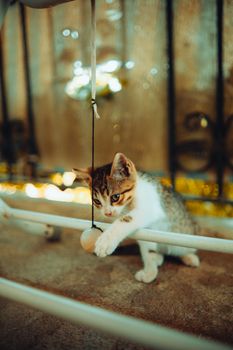
A Brain Built for a Hunt That Never Happens
An indoor cat lives roughly three times longer than an outdoor cat, and every welfare organisation worth listening to recommends keeping cats inside or in a secure enclosure. That part is settled. What is not settled is what happens to the animal inside the house.
A cat's nervous system is organised around a fixed sequence: scan, stalk, chase, pounce, catch, eat. Each stage releases a small amount of arousal and each stage has a resolution. A successful hunt closes the loop. When a cat is fed from a bowl twice a day, every stage of that sequence disappears at once, and the loop never closes. The energy does not vanish. It comes out sideways — as over-grooming, as 4 a.m. yowling, as a sudden ambush of an ankle, as a cat that sits by the door and stares.
So the goal of enrichment is not "buying more cat toys." It is restoring the stages of the sequence in a space where no mouse will ever appear.
The Five Stages, and What Each One Needs
| Stage | What it does for the cat | How to rebuild it indoors |
|---|---|---|
| Scan | Low-arousal vigilance; the cat feels in control of its territory | Height and a view: shelves, a cat tree by a window, a perch above the sofa |
| Stalk | Slow, silent approach; uses cover and patience | Boxes, tunnels, a cloth draped over a chair, a corridor of hiding spots |
| Chase | Fast pursuit; the highest-arousal stage | Wand toys moved in erratic, prey-like lines, never straight |
| Pounce / Catch | The payoff; the cat's body makes contact and grips | A toy the cat can actually grab and hold — not a laser dot it can never touch |
| Eat | Closes the loop; digestion and satiety | Food puzzles, scatter feeding, part of the daily ration delivered by hand |
Most homes have the first stage (a window) and skip the rest. A cat that can watch but never chase is a cat on permanent hold.
Vertical Space Is Not a Luxury
Cats resolve conflict vertically. Two cats that cannot share a floor can often share a room if there are enough heights. A single cat gains a sense of security from being able to get above the room and look down.
Practical minimum for one cat: three elevations that are not the floor — something at chair height, something at worktop height, and something above head height. They do not need to be expensive. A wall-mounted shelf, a stack of sturdy boxes, and a cleared bookcase shelf all count. What matters is that the cat can travel between them without touching the floor, because a route that touches the floor is a route that can be blocked.
Scratching: Location First, Texture Second
Owners usually buy a scratching post and then discover the cat prefers the sofa. The usual cause is placement, not preference. Cats scratch at the boundaries of their territory and next to where they rest, so a post tucked into a corner behind a plant gets ignored while the sofa arm — right where the cat wakes up — gets destroyed.
Put a scratching surface next to every place the cat sleeps and next to the main entry point of the room. Offer at least two textures: sisal rope for vertical stretching, and flat corrugated cardboard for horizontal raking. When a cat scratches, it is depositing scent from glands in the paws, stretching the spine, and marking territory. A post that wobbles defeats all three, so anchor it.
Play That Actually Satisfies
Two sessions a day of ten to fifteen minutes is the usual advice, and it is roughly right, but the quality matters more than the clock. Three rules make the difference:
- Play the sequence, not the toy. Drag the wand along the floor, hide it behind a chair, let it peek out, freeze, then run. A toy waved in the air from above is a bird; a toy skittering along the baseboard is a mouse. Match the movement to what your cat is hunting.
- Let the cat win. End with a catch. A session that always ends with the toy vanishing into a drawer teaches learned frustration.
- Feed after play, not before. A small meal immediately after a hunt session mimics the natural order and produces a visibly calmer cat. This single change fixes more "evening chaos" than any toy.
Never use a laser pointer as the only game. The cat completes the chase but can never complete the catch, and repeatedly dangling an unreachable prey item is one of the recognised contributors to compulsive behaviour.
Food as Enrichment
A bowl is the least interesting object in the house. Splitting the daily ration across a puzzle feeder, a snuffle mat, and a few hand-thrown kibbles adds ten to twenty minutes of problem-solving to every meal and slows eating, which matters for cats that bolt their food and vomit.
Wet food can be spread thinly on a plate or a silicone mat so the cat has to lick it up — this works especially well for cats that need more water intake.
Sensory and Social Layers
- Scent — cats navigate by smell. Bring in a cardboard box from a friend's house, or rub a cloth around a new object before it enters the cat's space.
- Sound — a radio at low volume gives the illusion of a populated house for cats that are alone all day. Sudden silence in an empty flat is more stressful than quiet noise.
- Sight — a bird feeder outside the main window turns a passive view into an active channel. It is the single highest-value enrichment purchase for most homes.
- Plants — wheatgrass or cat grass is safe to chew and provides fibre. Lilies, however, are acutely toxic to cats, including the pollen and the water in the vase, and should never be in the house.
- Touch — many cats want contact on their own terms. Sitting quietly nearby without reaching for the cat is itself enrichment.
Reading the Signal That Something Is Missing
Enrichment is failing when you see any of these:
- Barbering — bald patches, usually on the belly or the inside of the front legs, from over-grooming.
- Redirected aggression — the cat cannot get to the trigger, so it attacks whoever is nearest.
- Vocalisation at odd hours — most commonly between 3 and 5 a.m., when a cat's natural activity peaks.
- Object displacement — pushing items off shelves. This is a hunt substitute, not spite.
- Food obsession or the opposite — a cat that eats constantly out of boredom, or one that has lost interest in eating altogether.
Two or more of these, in a cat with no medical cause, means the environment needs the sequence rebuilt rather than more toys added.
Building It Room by Room
A practical redistribution, using what most homes already have:
- Window zone — perch plus a feeder outside. Serves scan.
- Corridor or hallway — two boxes, one tunnel. Serves stalk.
- Main living area — wand play twice daily, plus a scratching post beside the sofa. Serves chase and marking.
- Feeding station — puzzle feeder for at least one meal, and food spread out rather than piled. Serves eat.
- Sleeping spots — one high, one enclosed, one in the middle of family activity. Serves rest and control.
None of this requires buying a complete cat furniture set. It requires deciding, for each stage of the sequence, where the cat will be able to perform it tomorrow.
Frequently Asked Questions
Do indoor cats get bored?
Yes, and boredom in cats is not a mild emotion — it is a chronic stressor. Indoor life removes almost every stage of the hunting sequence that a cat's nervous system evolved around, so without deliberate substitution you tend to see over-grooming, night vocalisation, redirected aggression, or obesity rather than obvious "sadness."
How many hours a day should I play with my indoor cat?
Aim for two sessions of ten to fifteen minutes, one in the morning and one in the evening. The quality of those sessions matters more than the total: move the toy as prey moves, allow a catch at the end, and follow play with a small meal so the sequence finishes properly.
Is a cat tree really necessary?
Something that provides elevation is necessary; a dedicated cat tree is not. You need at least three levels above the floor that the cat can reach without using the floor between them. Shelves, boxes, and cleared bookcase space work just as well as commercial furniture.
Why does my cat scratch the sofa instead of the scratching post?
Placement is usually the culprit rather than the surface. Cats scratch next to where they sleep and at the edges of their territory, so a post hidden in a corner is ignored while the sofa arm the cat wakes up against gets shredded. Put a scratching surface beside every sleeping spot and near the room's entry point, and anchor it so it does not wobble.
Is it cruel to keep a cat indoors?
No, provided the environment substitutes for what the outdoors would have provided. Indoor cats live substantially longer and face far less risk of traffic, infectious disease, and predation. The obligation that comes with keeping a cat inside is to supply vertical space, hunting-style play, food-based problem solving, and sensory variety yourself.
Do laser pointers harm cats?
They can contribute to compulsive behaviour when used as the only game. The cat completes the chase but can never complete the catch, and repeatedly presenting an unreachable target is a recognised source of frustration. If you use one, always finish by landing the dot on a physical toy the cat can grab and bite.