Origin and Recognition
The Siberian cat, known as the Siberian Forest Cat, originated in the dense forests of Siberia, Russia, and has been a part of Slavic folktales, rural lore, and artwork dating back to the 10th century. This landrace cat became a formal breed with standards promulgated worldwide since the late-1980s. Recognized for registry and championship status since 2006 by all major cat registries, the Siberian is the national cat of Russia.
Its first mention outside Russia was in the 1864 edition of the German book Brehms Tierleben, where it was described as a "red Tobolsk cat from Siberia. " The breed was again mentioned in books by Harrison Weir in 1889 and 1892, under the name "Russian Long-haired Cat. " After the fall of the Berlin Wall and the dissolution of the Soviet Union, a second wave of Siberian cats were introduced to the rest of the world, leading to the development of an officially acknowledged cat breed.
Today, Siberian cats are selectively bred and pedigreed in all major cat registries under the category 'Siberian (Forest) Cat', or in several registries under 'Neva Masquerade' for the colourpoint sister breed. This ensures that all Siberian cats are purebred with a formally registered ancestry, contributing to the breed's health and vitality.
Physical Description
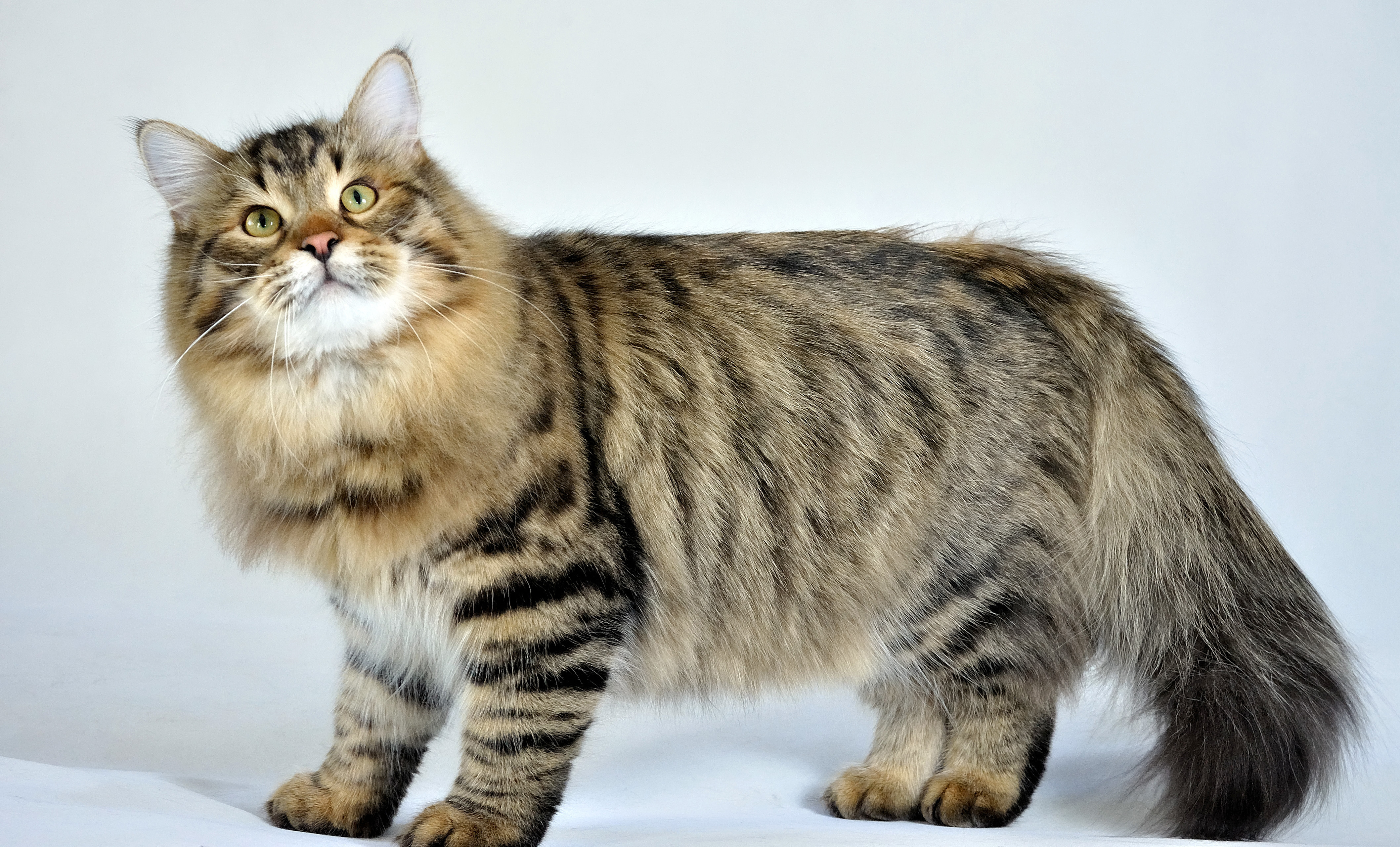
The Siberian is a medium to large-sized, muscular breed with a bushy tail. Known for its agility, the Siberian has strong hindquarters and large, well-rounded paws, with relatively short legs. The body is firm, barrel-shaped, and stockier than other cats, giving it a round and muscular appearance. Siberians develop slowly, reaching full maturity at about five years of age, with females being considerably smaller than males, weighing on average between 4.5 to 9 kg.
The face of the Siberian is round, with a broad forehead and a full, rounded short muzzle. Large, round eyes give the cat a sweet expression, and medium-sized ears are broad at the base and rounded at the tip, slightly tilted forwards. Lynx ear tipping is allowed.
The coat of the Siberian is semi-long to long, well-developed, and very dense, consisting of guard hair, awn hair, and down hair. This triple-coat is water-repellent and provides excellent protection against the harsh Russian weather. The summer coat is distinctly shorter than the winter coat, and Siberians moult twice a year, shedding their heavy winter coat during spring.
Coat Colors and Patterns
Western coat colours and patterns are genetically possible in the Siberian breed, including tabby, solid, tortoiseshell, and bicolour. The most common colour is black (brown) mackerel tabby, with Western coat colours such as white, black, blue, red, and cream being prevalent. The Eastern colour varieties of chocolate, lilac, cinnamon, and fawn are not permitted in the Siberian breed. The allowance for the dilution modified caramel and apricot depends on the registry.
Completely white Siberian cats are not considered Neva Masquerades, as they do not necessarily possess the colourpoint gene. Solid-white Siberian cats can also have blue eyes, which is due to a lack of melanin pigment and not a result of the colourpoint gene. However, white cats have a higher prevalence of genetic deafness and are often advised to be tested for this trait before breeding.
Siberians come in all eye colours, but clear colours are desirable. Several registries only allow blue and odd eyes in the solid-white and bicolour varieties, leaving only colours in the golden-copper to green spectrum for other coats. The solid-white Siberian has four permitted eye colours: blue, green, golden-copper, and odd-eyed.
Temperament and Personality
The Siberian cat is known for its dog-like temperament and affection, making it an ideal lap cat. It is curious, intelligent, loyal, sweet, agile, playful, and affectionate. This breed is very adaptable and can live quite happily indoors, although its high energy level means it enjoys play and exercise. The Siberian is also highly trainable and can be a great companion for families with children and other pets.
Despite its high energy level, the Siberian is also known for its calm and relaxed nature. It is not overly vocal, which makes it a great pet for those who prefer a quieter household. However, it does enjoy interacting with its owners and requires regular social interaction to stay happy and healthy.
Health and Genetics
The Siberian is a generally healthy breed, but like all cats, it can be prone to certain health issues.
Siberians are genetically closely related to Norwegian Forest cats and the random-bred Northern European cat populations. This genetic diversity contributes to the breed's overall health and vitality.
Those with allergies should consult with a veterinarian before bringing a Siberian into their home.
Breed Standards and Popularity
The Siberian breed has specific standards that cover ideal characteristics in both appearance and character. These standards are applied by all major cat registries and are used to judge Siberian cats in cat shows. The breed standards include criteria for physical and morphological appearance, genetics, and athletic or productive performance.
Since its introduction worldwide in the late-1980s, the Siberian has gained popularity, particularly in the 2020s. It now represents approximately 0-5% of all pedigree cats worldwide and is particularly popular in Europe. The Siberian has secured a place among the top 10 most popular breeds in various cat registries.
Despite its growing popularity, the Siberian remains relatively rare outside of Eastern Europe due to the expense of importing the cats from Eastern Europe and the common breeder's practice of early neutering pedigree kittens.
Buying a Siberian
- Ensure the breeder is registered with a major cat registry and adheres to breed standards.
- Meet the parents of the kitten to assess their temperament and health.
- Ask about the kitten's diet and exercise routine.
- Ensure the breeder provides a contract and a guarantee for the kitten's health.
Buying a Siberian can be an investment, with prices ranging from $500 to $1500 or more, depending on the breeder, location, and the kitten's lineage.
Before bringing a Siberian into your home, ensure that your household is suitable for this energetic and affectionate breed.
Frequently Asked Questions
What is the lifespan of the Siberian?
The average lifespan of the Siberian is about 12 - 15 years. Good nutrition and regular veterinary care support a healthy life.
What is the temperament of the Siberian?
The Siberian is known for: Curious, Intelligent, Loyal, Sweet, Agile, Playful, Affectionate. Its affection rating is very high. Its energy level is high.
What size and weight is the Siberian?
It is a medium-sized cat, typically around 4 - 7 kg as an adult.
Is the Siberian easy to care for?
Available ratings indicate relatively low grooming needs, and moderate shedding. Routine brushing, ear and dental care, and nail trims are still recommended.
Is the Siberian good with kids and other pets?
Available ratings indicate high child-friendliness, and very high pet-friendliness. Supervised, gradual introductions are recommended.
How much exercise does the Siberian need?
With a high energy level, it needs walks, play or training matched to its stamina.
Is the Siberian hypoallergenic?
It has some hypoallergenic traits, but reactions vary. Spend time with one and seek professional advice before deciding.



