Origin and Development
The American Bobtail, an uncommon breed of domestic cat, originated in the late 1960s in the United States. This breed is distinguished by its distinctive "bobbed" tail, which is about one-third to one-half the length of a normal cat's tail. This unique trait is the result of a genetic mutation affecting tail development, similar to that of the Manx cat. The American Bobtail is not related to other short-tailed breeds such as the Cymric, Japanese Bobtail, or Kurilian Bobtail, despite the similar appearance. The mutation causing the American Bobtail's short tail is dominant, whereas the Japanese Bobtail's tail mutation is recessive.
Urban legend suggests that Bobtails are the result of crossbreeding a domestic tabby cat with a wild bobcat. However, the unusual tail is actually due to a random spontaneous genetic mutation within the domestic cat population. This mutation may be related to the Manx gene, which is also dominant. The original bloodline of the American Bobtail was created by mating a short-tailed brown tabby male named Yodie with a seal-point Siamese female. Most of the early bloodlines have since died out.
The breed's original appearance genetics were modified to form a new and improved strain, resulting in essentially all colors and coat types. The American Bobtail was first recognized by The International Cat Association (TICA) in 1989. It has been accepted for championship competition by TICA, the Cat Fanciers' Association (CFA), and the American Cat Fanciers Association (ACFA). The breed is also technically sanctioned in the Cat Aficionado Association (CAA) of China, although it is unknown if any specimens are actually in China. The American Bobtail is recognized as both American Bobtail Longhair and American Bobtail Shorthair in the Germany-based World Cat Federation (WCF), but it is not accepted for competition and has no WCF breed standard.
Physical Characteristics
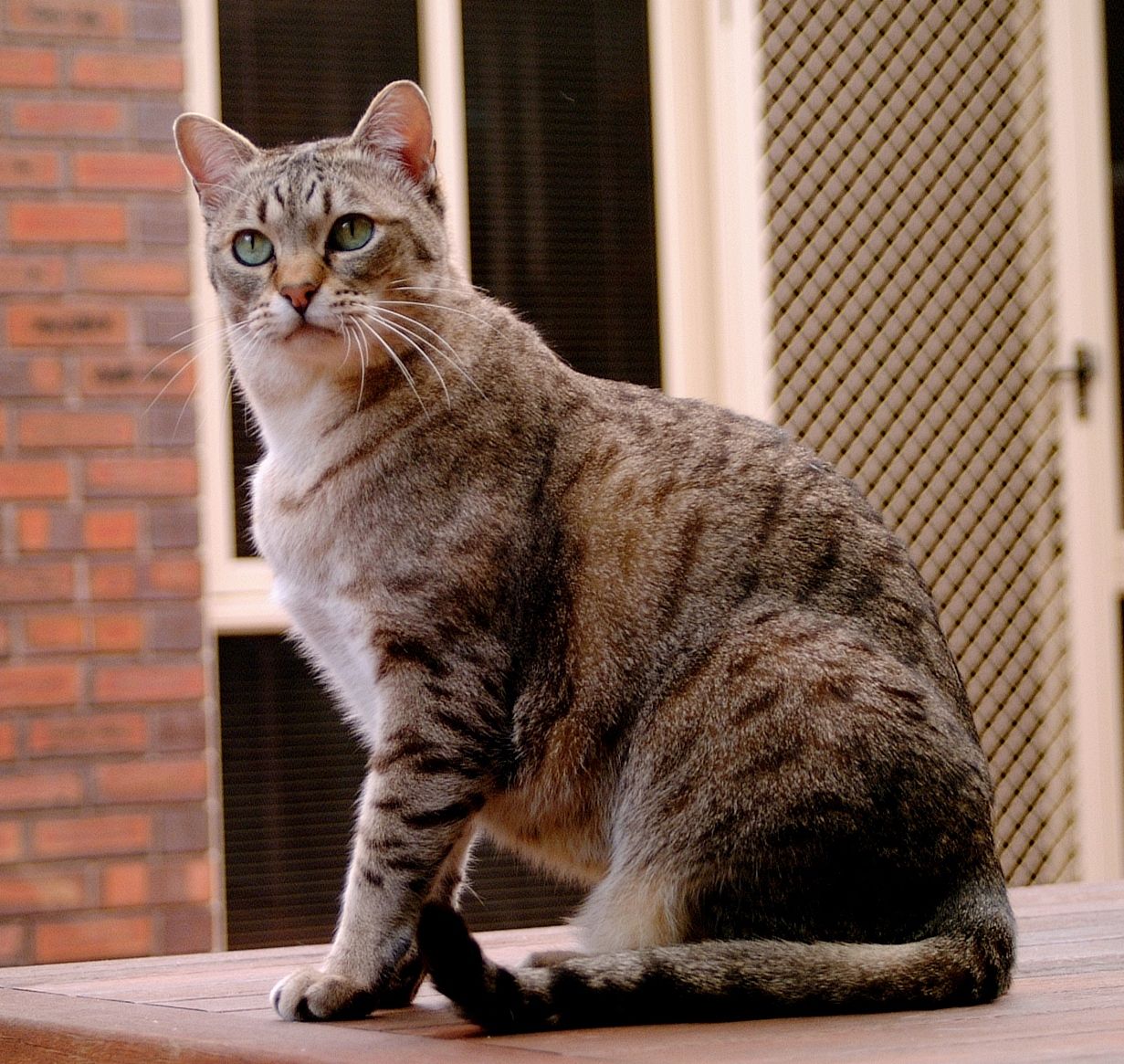
The American Bobtail is a hearty, short-tailed cat with a body that is moderately long and stocky. Its stance is notably rectangular, and the torso is full and broad. The hips are substantial, almost as wide as the chest, and the hind legs are longer than the fore legs, with large round feet that may have toe tufts. The head is a broad wedge without flat planes, and its size is proportionate to the body. The nose to brow has a concave curve, and the muzzle is broad and unpinched. Whisker pads are prominent, and the nose is gently sloped and wide. The jaws are full and strong. The ears are medium-sized, wide-based, and equally mounted on top and the side of the head with rounded tips. The eyes are almost almond-shaped and proportionate to the head, with an aperture that is angled to the base of the ear and medium wide spacing and deep sockets. Eye color varies with coat color, and the end of the tail is visible above the back but not beyond the hock when the cat is in repose. The tail can be straight or curved, slightly knotted, or may have bumps.
While the "bobcat-" or "ocelot"-like spotted coat patterning is the most basal coloration seen on the breed, many other colors and patterns exist, including black, blue, brindle, brown, calico, chocolate, cinnamon, fawn, lilac, pied, red-and-cream, peach or orange tabby, or tortoiseshell. These colors can be found in both long and shorthair varieties.
The American Bobtail requires two to three years to develop, which is slower than many domestic cat breeds. This slower development period contributes to the breed's sturdy and robust nature.
Temperament and Behavior
American Bobtails are known for their intelligent, interactive, lively, playful, and sensitive nature. They are highly adaptable to new environments, making them suitable companions for travelers. This breed is considered to be among the most "dog-like" of any cat breed, as they boldly greet visitors to the home and never shy away from an opportunity to play, hunt, or socialize. They have been called miniature "ocelots" due to their climbing abilities and enjoy exploring, jumping, and stalking birds and small animals. American Bobtails readily come to humans and other pets for affection, including dogs.
As kittens, American Bobtails are particularly energetic and playful. They retain much of this playful nature into adulthood, making them a fun and engaging pet. Their high energy level and playful nature make them a great choice for families with children or other pets.
Despite their playful and energetic nature, American Bobtails are also known for their low level of friendliness towards strangers. This can be beneficial for those looking for a cat that is not overly social with unfamiliar people.
Health and Genetic Considerations
The American Bobtail is generally a healthy breed with a life span of 11 to 15 years. One such issue is the potential for a genetic mutation that can affect the tail development, leading to a bobbed tail. While this mutation is not harmful, it is a distinctive trait of the breed.
Another potential health concern is related to the breed's high energy level and playful nature.
The breed's genetic makeup has been carefully managed to ensure a healthy and robust population.
Coat and Grooming
American Bobtails have a medium-length coat that is shaggy rather than dense or fluffy.
The grooming requirements for the American Bobtail are relatively low compared to other breeds.
Adaptability and Compatibility
American Bobtails are highly adaptable to various living situations, making them suitable for a wide range of owners. Their adaptability rating of 5 out of 5 indicates their ability to adjust to new environments and situations. This makes them a great choice for families, individuals, and those with busy lifestyles.
They are also highly affectionate and bond well with their human family, with an affection level rating of 5 out of 5. This makes them ideal companions for those seeking a loyal and loving pet. Their social needs rating of 3 out of 5 suggests that they enjoy human interaction but can also be content with some alone time.
When it comes to compatibility with other pets, American Bobtails have a high dog-friendly rating of 5 out of 5. They can coexist harmoniously with dogs and other pets, making them a great choice for multi-pet households.
Buying and Owning an American Bobtail
Responsible breeders prioritize the health and welfare of their cats and can provide information about the breed's specific needs and care requirements.
While the initial purchase price may vary depending on the breeder and the kitten's bloodline, ongoing costs such as food, grooming, and veterinary care should be taken into account.
Providing scratching posts, climbing trees, and interactive toys can help keep your American Bobtail entertained and engaged.
Frequently Asked Questions
What is the lifespan of the American Bobtail?
The average lifespan of the American Bobtail is about 11 - 15 years. Good nutrition and regular veterinary care support a healthy life.
What is the temperament of the American Bobtail?
The American Bobtail is known for: Intelligent, Interactive, Lively, Playful, Sensitive. Its affection rating is very high. Its energy level is high.
What size and weight is the American Bobtail?
It is a medium-sized cat, typically around 3 - 7 kg as an adult.
Is the American Bobtail easy to care for?
Available ratings indicate low grooming needs, and moderate shedding. Routine brushing, ear and dental care, and nail trims are still recommended.
Is the American Bobtail good with kids and other pets?
Available ratings indicate high child-friendliness, and very high pet-friendliness. Supervised, gradual introductions are recommended.
How much exercise does the American Bobtail need?
With a high energy level, it needs walks, play or training matched to its stamina.