Origin and Early History
The Siamese cat, known as Maeo Thai in Thailand, originated from the Wichianmat landrace, one of several cat varieties native to Thailand, which was known as Siam before 1939. Its history dates back to the Ayutthaya Kingdom, with ancient manuscripts called the Tamra Maew (The Cat-Book Poems) depicting the Wichianmat cat as rare and valuable, almost as precious as gold. The breed was selectively bred since the end of the 19th century, with the first documented Siamese cat reaching the United States in 1878. The modern Siamese breed was established by crossbreeding with other cats, including Persians and domestic longhair cats, to introduce the point markings and colors.
During the Burmese–Siamese war in 1767, the Burmese army sacked the capital, taking Siamese noblemen and royal family members as captives. A Thai legend tells that the King of Burma, Hsinbyushin, found the poem of the Wichianmat cats in the Tamra Maew and ordered his army to bring all the cats back to Myanmar (Burma) as treasures.
The Siamese cat became one of the most popular cat breeds in Europe and North America in the 19th century. By the 1950s, the modern-style Siamese with its slender and angular features became the preferred type, leading to the separation of the traditional "old-style" cats, which were re-established as the separate Thai cat breed in the 1980s. The Siamese is used as foundation stock in several new cat breeds, including the Balinese and the Himalayan.
Appearance and Characteristics
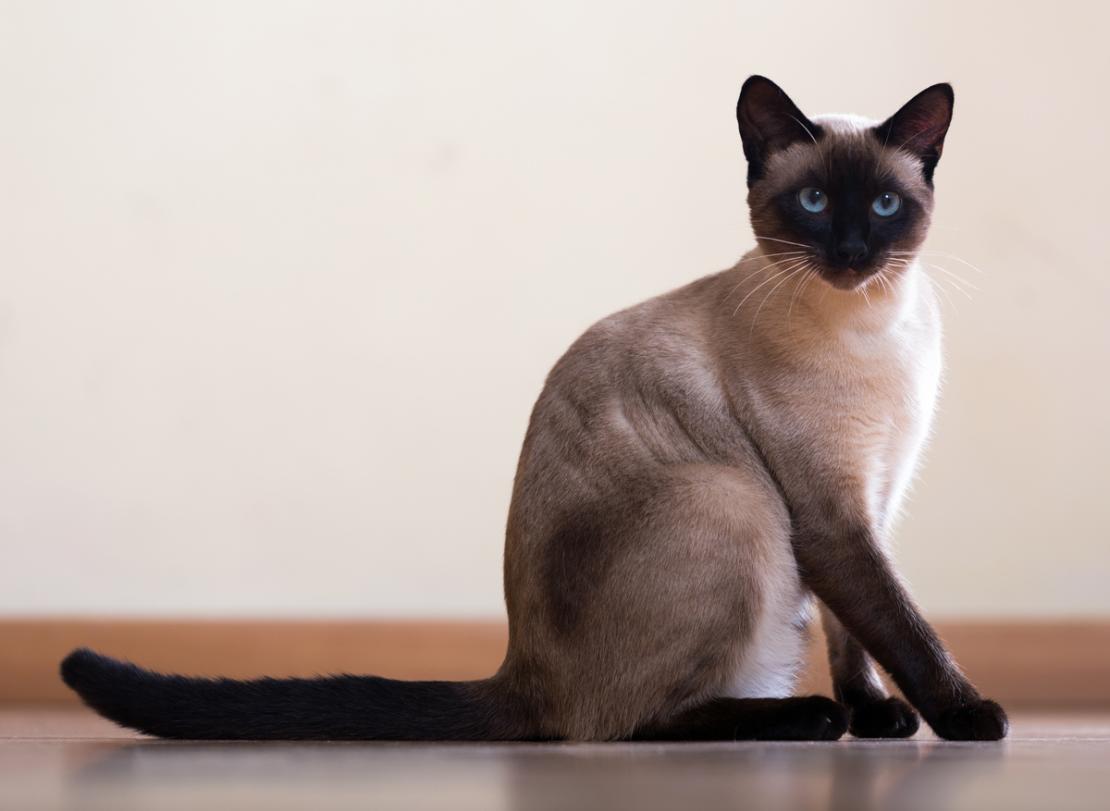
The Siamese cat has a distinctive colorpoint coat resulting from a temperature-sensitive type of albinism. It features blue almond-shaped eyes, a triangular wedged head shape, large wide-set ears, an elongated, slender, and muscular body, and various colors of point coloration. The modern Siamese breed has an elongated, tubular, and muscular body, a triangular head, and a long, wedge-shaped head topped by extremely large, wide-set ears. The fur is short, glossy, fine, and adheres to the body without an undercoat. The colorpoint pattern is a form of partial albinism, with the mutated tyrosinase enzyme failing to work at normal body temperatures but becoming active in cooler areas of the skin, resulting in dark coloration in the extremities and face.
Originally, the majority of Siamese had black ('seal') points, but other colors such as blue, chocolate, and lilac were eventually accepted. The breed has been crossbred with other breeds to introduce various colors and patterns, including red and cream points, tabby points, and tortoiseshell points. The modern Siamese shares the pointed color pattern with the Thai but differs in head and body type.
The Siamese cat is known for its active, agile, clever, sociable, loving, and energetic temperament. It is highly affectionate and intelligent, often described as a "extrovert" that enjoys being with people and bonds strongly with a single person. The Siamese is also known for its vocalization and is talkative and opinionated, following its owner around and supervising their every move.
Breed Development and Registration
The Siamese cat is one of the first distinctly recognized breeds of domestic cat, pedigreed in all major cat fancier and breeder organizations. The breed was selectively bred in the West from the Wichianmat, with the first documented import to the United States in 1878. By 1886, four Siamese cats were imported to the UK, forming the foundation stock for the breed in Britain. The original imports were called the "Royal Cat of Siam," and it is possible to trace the pedigree of most Siamese cats back to these original imports.
In the 1950s–60s, breeders and cat show judges began to favor the more slender look, leading to the creation of increasingly long, fine-boned, narrow-headed cats through selective breeding. The modern show Siamese was bred to be extremely elongated, with a lean, tubular body, long, slender legs, a very long, very thin tail, and a long, wedge-shaped head topped by extremely large, wide-set ears. By the mid-1980s, the traditional "old-style" cats had largely disappeared from cat shows, resulting in the establishment of the separate Thai cat breed.
The modern Siamese breed is used as foundation stock in several new cat breeds, including the Balinese, Himalayan, and Javanese. The Oriental and Colourpoint Shorthair were developed to expand the range of Siamese coat patterns, and crossbreeding with Persians resulted in the Himalayan. The long-haired Siamese is recognized internationally as the Balinese.
Popularity and Rankings
In the 2024 statistics of FIFe, one of the major global cat registries, the Siamese breed ranked at position 17 out of 54 breeds in popularity, comprising 1% of the total registered kittens that year, which translates to 929 cats. The Siamese has been a popular breed in Europe and North America since the 19th century and remains a favored choice among cat enthusiasts.
The breed's popularity is reflected in its high ratings in various categories. It scores 5 out of 5 in adaptability, affection level, energy level, intelligence, social needs, and stranger-friendly behavior.
Health Considerations
While the Siamese cat has a life expectancy of 12 to 15 years, it is prone to certain health issues. Swedish insurance data shows that Siamese and Siamese-derived breeds have a higher mortality rate than other breeds, with 68% living to 10 years or more and 42% to 12.5 years or more. The majority of deaths are caused by neoplasms, mainly mammary tumors. The Siamese also has a higher rate of morbidity, with a predisposition to neoplastic and gastrointestinal problems but a lower risk of feline lower urinary tract disease.
The Siamese cat has been found to have a predisposition to several health conditions, including abnormal visual projections due to the lateral geniculate body of the eye, progressive retinal atrophy, and gangliosidosis 1, an autosomal recessive mutation in the GBL1 gene. The breed also suffers from periocular leukotrichia, pinnal alopecia, and psychogenic alopecia, and young Siamese cats are predisposed to histiocytic cutaneous mast cell tumors.
Early detection and treatment of health issues can significantly improve the quality of life for Siamese cats.
Buying a Siamese Cat
When considering buying a Siamese cat, there are several factors to keep in mind. First, be aware of the breed's high energy level and social needs. They are affectionate and require attention, making them a good fit for families or individuals who can provide consistent companionship.
While the initial purchase price may be moderate, the ongoing costs of food, veterinary care, and grooming can add up.
When looking for a Siamese cat, it is advisable to purchase from a reputable breeder who can provide information about the cat's health and lineage. Ensure that the breeder is a member of a recognized cat registry and has a good reputation for ethical breeding practices. This will help ensure that you are getting a healthy, well-socialized cat.
Frequently Asked Questions
What is the lifespan of the Siamese?
The average lifespan of the Siamese is about 12 - 15 years. Good nutrition and regular veterinary care support a healthy life.
What is the temperament of the Siamese?
The Siamese is known for: Active, Agile, Clever, Sociable, Loving, Energetic. Its affection rating is very high. Its energy level is high.
What size and weight is the Siamese?
It is a medium-sized cat, typically around 4 - 7 kg as an adult.
Is the Siamese easy to care for?
Available ratings indicate low grooming needs, and relatively low shedding. Routine brushing, ear and dental care, and nail trims are still recommended.
Is the Siamese good with kids and other pets?
Available ratings indicate high child-friendliness, and very high pet-friendliness. Supervised, gradual introductions are recommended.
How much exercise does the Siamese need?
With a high energy level, it needs walks, play or training matched to its stamina.
Is the Siamese hypoallergenic?
It has some hypoallergenic traits, but reactions vary. Spend time with one and seek professional advice before deciding.



