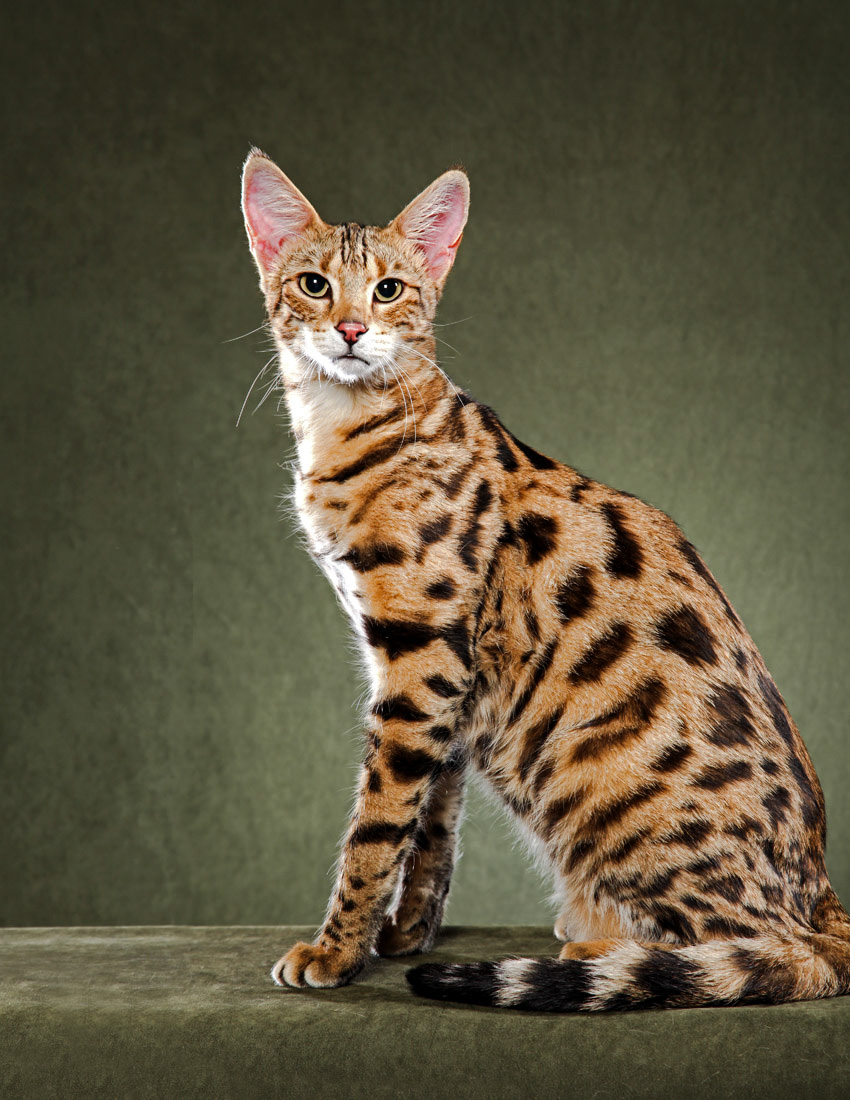
Savannah Cat Overview
The Savannah cat, a hybrid of a serval (Leptailurus serval) and a domestic cat (Felis catus), is a unique breed developed in the late 20th century. It is known for its large size, typically weighing between 4.5 to 11 kg (9.9 to 24.3 lb) in early generations (F1-F2), with some individuals reaching as much as 18 kg (40 lb) or more. The Savannah is often referred to as the "feline version of a dog," characterized by its active nature and social behavior.
Originating in the United States, the first Savannah cat was bred on April 7, 1986, when Judee Frank crossed a male serval with a Siamese domestic cat. This pioneering cat, named Savannah, later bred with a Turkish Angora male to produce the first F2 kittens in April 1989. The breed was officially recognized by The International Cat Association (TICA) in 2001 and achieved championship status in May 2012.
Appearance and Size
The Savannah has a tall and slim build, which contributes to its larger appearance than its actual weight. Males tend to be larger than females, and the F1 and F2 generations are usually the largest due to the strong serval genetic influence. The F4-F5 generations, however, are comparable in size to other large domestic cat breeds, typically weighing between 5.0 to 8.2 kilograms (11.0 to 18.1 lb). The distinctive features of the Savannah include large ears, black spotted coats, long bodies and legs, and wide noses.
The coat of a Savannah should have a spotted pattern, the only pattern accepted by the TICA breed standard. The standard also allows four colors: black spotted tabby, black silver spotted tabby, black, and black smoke. Non-standard patterns and colors can occur, including rosettes, marble, "snow" (point), blue, cinnamon, chocolate, lilac (lavender), and other diluted colors derived from domestic cat coat genetics.
Temperament and Behavior
Savannah cats are known for their curious, social, and intelligent nature. They actively seek social interaction and can be prone to pouting if left out. Their behavior can be reminiscent of dogs, making them excellent companions for those looking for an animal that is loyal, intelligent, and eager to be involved. They are also outgoing and adventurous, and their high energy level can be compared to that of a dog.
While the earlier generations (F1-F2) can exhibit some wild or territorial behaviors, particularly in males, and may have issues with aggression and marking, they do not fear water and often enjoy playing in or immersing themselves in it. Litter box training can sometimes be a challenge for this breed, which may lead to owners surrendering them to rescue centers.
Reproduction and Genetics
Savannah cats are produced through hybridization, and each generation is marked with a filial number (F#). The F1 generation is 50% serval and sterile due to the significant difference in gestation periods between the serval and domestic cat. The F2 generation ranges from 25% to 37.5% serval and is the offspring of the F1 generation female. The F4 generation is considered the first "stud book tradition" (SBT) cat and is considered "purebred. "
Outcrossing played a significant role in the breed's development in the early days, but since 2012, domestic outcrosses are no longer permitted. Breeders use F5 males to produce the F2 generation with a F1 female.
Health Considerations
Savannah cats are prone to certain health issues, including hypertrophic cardiomyopathy (HCM), which can affect heart function. Progressive retinal atrophy (PRA) and pyruvate kinase deficiency (PK-Def) are also concerns, as they can lead to blindness and anaemia, respectively. Due to their unique genetics, Savannahs and servals have similar anesthesia requirements to other domestic cat breeds and hybrids, and certain anesthetics are known to be safe for use.
Legal Restrictions
The laws governing the ownership of Savannah cats in the United States vary by state, with some states having more restrictive laws on ownership. In Australia, the importation of Savannah cats is banned due to concerns that they could threaten native wildlife. Similarly, New Zealand has banned the importation of hybrid dogs and cats, excluding Bengal cats. Canada allows ownership in all provinces, although some provinces have restrictions on the ownership of F1 and F2 generations.
Belgium and the Netherlands have laws that make it illegal to own or breed servals and their F1-4 generation hybrid Savannah offspring. Other nations have fewer or no restrictions on F2 and later generations, making the Savannah cat a unique breed with specific legal considerations depending on the location.
Buying a Savannah Cat
A Savannah may be the right pet for an active family with a home that can accommodate its size and energy. It is also crucial to be prepared for the potential health issues associated with the breed, such as HCM and PK-Def, and to have a budget in place for the care and maintenance of a Savannah cat, which can be a significant investment.
- Ensure the breeder is reputable and has a good history with TICA.
- Ask about the cat's health clearances and genetic screening results.
- Prepare for the potential for higher veterinary costs due to the breed's unique health needs.
- Consider the long-term commitment, as Savannah cats can live up to 17-20 years.
Breed Standard and Registry
The TICA breed standard for Savannah cats outlines the ideal characteristics of the breed. The standard includes specific requirements for the cat's size, coat, color, and temperament. For example, the standard specifies that the Savannah should have a spotted coat pattern, with the only acceptable color being black. The standard also details the ideal height and weight for each generation, with F1 and F2 cats being larger than F3 and F4 cats.
The breed's registry history is marked by the development of the stud book tradition (SBT) cats, which began with the F4 generation. These cats are considered purebred and are the result of careful breeding to maintain the breed's characteristics. The registry process involves documenting the lineage of each cat, ensuring that they meet the breed standard set by TICA.
Frequently Asked Questions
What is the lifespan of the Savannah?
The average lifespan of the Savannah is about 17 - 20 years. Good nutrition and regular veterinary care support a healthy life.
What is the temperament of the Savannah?
The Savannah is known for: Curious, Social, Intelligent, Loyal, Outgoing, Adventurous, Affectionate. Its affection rating is very high. Its energy level is moderate.
What size and weight is the Savannah?
It is a medium-sized cat, typically around 4 - 11 kg as an adult.
Is the Savannah easy to care for?
Available ratings indicate low grooming needs, and moderate shedding. Routine brushing, ear and dental care, and nail trims are still recommended.
Is the Savannah good with kids and other pets?
Available ratings indicate high child-friendliness, and very high pet-friendliness. Supervised, gradual introductions are recommended.
How much exercise does the Savannah need?
With a moderate energy level, it needs walks, play or training matched to its stamina.



