Origin and History
The British Shorthair, a pedigreed cat breed, originated in the United Kingdom, stemming from the ancient landrace of British domestic cats. This landrace, one of the oldest known cat breeds, was selectively bred into a pedigreed cat by the end of the 19th century. The breed gained full recognition status in all major cat registries and remains the most popular pedigreed breed in its native country, as reported by the UK's Governing Council of the Cat Fancy (GCCF), with half of all kittens registered being British Shorthairs.
Historically, the British Shorthair interbred with the local European wildcat population, developing into robust cats with a thick coat to withstand the British Isles' conditions. It was one of the domestic cats bred for hunting prowess, first introduced to Britain by the Romans. The breed made its debut at the first-ever cat show in 1871, organized by Harrison Weir, and remained the premiere pedigree at cat shows until 1895.
After World War I, breeding stock became critically rare, and breeders mixed Persians, Russian Blue, Burmese, and Chartreux into their bloodlines. By the late 1970s, the distinctive British Shorthair had achieved full recognition status, thanks to the efforts of breeders like those working with the French Chartreux, another ancient breed genetically unrelated but similar in appearance.
Breed Characteristics
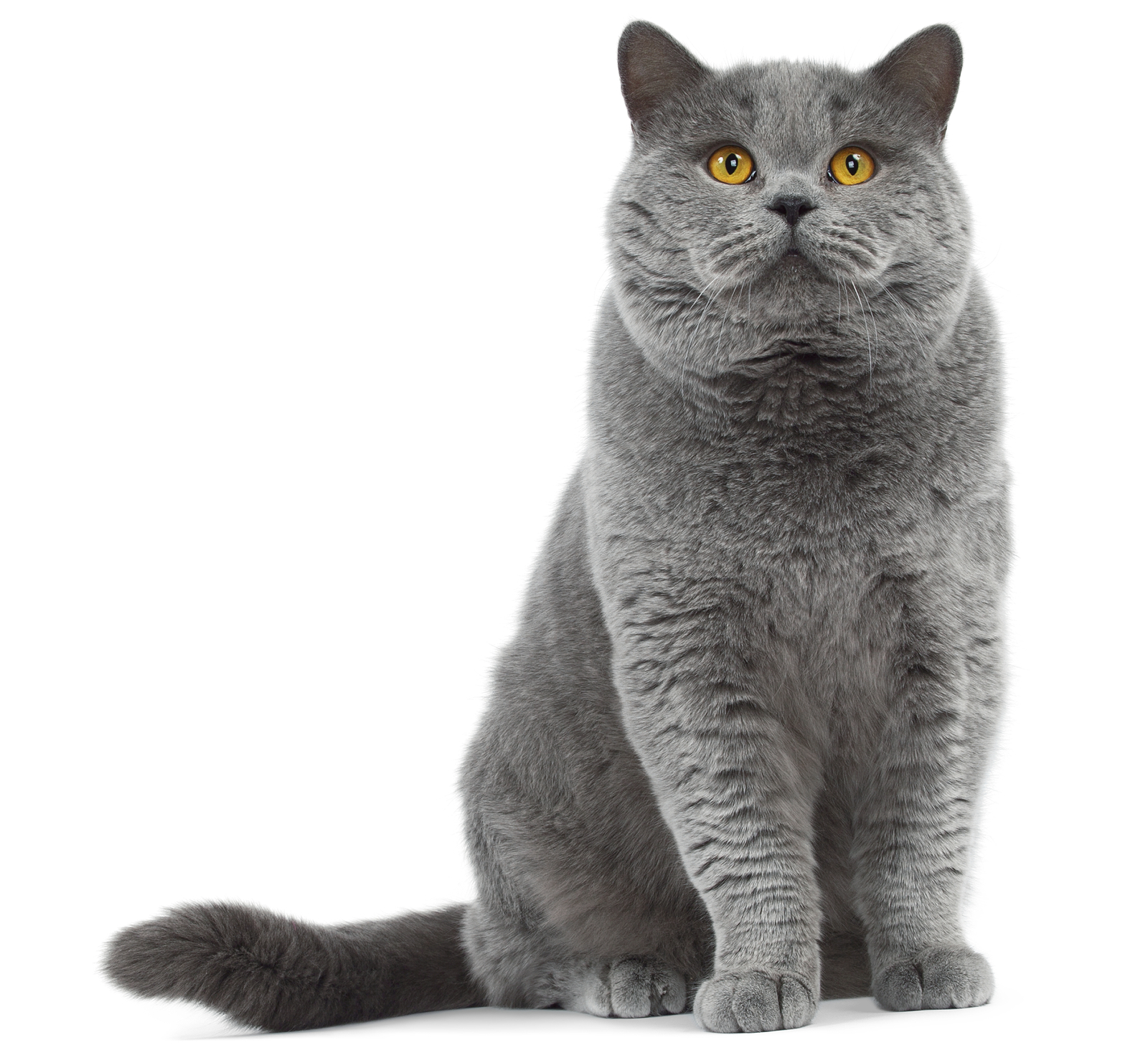
The British Shorthair is a large, powerful-looking cat with a broad chest, sturdy legs, and rounded paws. The body is muscular and well-boned, supported by medium to short legs and finished with round, medium-to-large feet. The tail is medium in length, thick at the base, and tapering to a rounded tip, measuring roughly two-thirds of the body length.
The head is large and distinctly rounded, with a short muzzle, full cheeks, and a short nose with a gentle profile. The chin and muzzle complement the circular head shape, and the neck blends into the cheeks, creating the impression of little or no visible neck. The ears are small to medium in size, broad at the base, and set widely apart. The eyes are large, round, and level-set; eye shape is considered more important than color.
British Shorthairs mature relatively slowly, reaching full physical development at around three years of age. They are a sexually dimorphic breed, with males averaging 4–8 kg (9–17 lb) and females 3–5 kg (7–12 lb). Their coat is dense, straight, and even in length, with a plush texture and a firm, "crisp" pile that breaks noticeably over the body as it moves.
Temperament and Personality
The British Shorthair is known for its pleasant and easygoing temperament. They are affectionate, gentle, loyal, and patient, making them great companions. Despite their loving nature, they are not demanding and do not require hourly attention. If in the mood to play, they will find someone and bring a toy to that person, and they also play well by themselves, making them a good companion for single people.
The breed's calm demeanor has made it a frequent media star, notably as the inspiration for John Tenniel's famous illustration of the Cheshire Cat from Alice in Wonderland. Their adaptability and social needs are moderate, and they are friendly with both children and dogs, earning them a rating of 4 and 5, respectively, out of 5 on the adaptability and dog-friendly scales.
Coat, Color, and Patterns
The British Shorthair's coat is one of the breed's defining features, known for its density and straightness. The texture is plush rather than woolly or fluffy, with a firm, "crisp" pile that breaks noticeably over the cat's body as it moves. While the British Blue remains the most familiar variant, the breed has been developed in many other colors and patterns, including white, black, blue, red, cream, cinnamon, and fawn.
The GCCF, FIFe, and TICA accept chocolate and its dilute lilac, while the CFA does not. All base colors can be affected by the silver and golden genes in smoke, shaded, and tipped variants. The breed also recognizes the four acknowledged tabby patterns: classic, mackerel, spotted, and ticked tabby. All colors and patterns occur in the variants resulting from the combination with colorpoint, bicolour (white spotting), and/or tortoiseshell.
Health and Lifespan
On average, the British Shorthair has a lifespan of 12 to 17 years, with Swedish insurance data putting the median lifespan at over 12.5 years. A study of over 190,000 patient records in England found that 82% of British Shorthairs lived to 10 years or more, and 54% lived to 12.5 years or more. However, the breed is at a high risk of polycystic kidney disease (PKD) and hypertrophic cardiomyopathy (HCM), a condition where the heart muscle becomes thickened, reducing the heart's ability to pump blood effectively.
Male British Shorthairs are more likely to have HCM, with a prevalence of 20.4%, while females have a lower prevalence of 2.1%. Testing of males used for breeding is now mandatory for breeders organized under the Danish FIFe member, Felis Danica. Owners should be aware of these conditions and consult with their veterinarian for regular health checks.
Breed Popularity and Recognition
The British Shorthair has been a popular breed for decades, holding the title of the UK's most popular cat breed for many years. As of 2024, the breed ranked at position 2 out of 54 breeds in popularity in the Fédération Internationale Féline (FIFe), comprising 16.9% of their total registered kittens that year. This popularity is also reflected in the United States, where the British Shorthair ranks as the 6th most popular cat breed.
The breed's popularity can be attributed to its unique appearance, temperament, and history. Their presence in 19th and 20th-century cat shows, as well as their feature in competitions by the Cat Fanciers' Association (CFA) in the 1980s, has helped increase demand for British Shorthairs as household pets.
Buying a British Shorthair
- Ensure the breeder is a member of a recognized cat registry like the GCCF, FIFe, or TICA.
- Ask for health clearances for conditions like HCM and PKD.
- Observe the kitten's behavior and temperament to ensure they are well socialized and adaptable.
- Consider the cost of owning a British Shorthair, including food, vet care, and potential treatment for health issues.
Frequently Asked Questions
What is the lifespan of the British Shorthair?
The average lifespan of the British Shorthair is about 12 - 17 years. Good nutrition and regular veterinary care support a healthy life.
What is the temperament of the British Shorthair?
The British Shorthair is known for: Affectionate, Easy Going, Gentle, Loyal, Patient, Calm. Its affection rating is high. Its energy level is low.
What size and weight is the British Shorthair?
It is a medium-sized cat, typically around 5 - 9 kg as an adult.
Is the British Shorthair easy to care for?
Available ratings indicate relatively low grooming needs, and high shedding. Routine brushing, ear and dental care, and nail trims are still recommended.
Is the British Shorthair good with kids and other pets?
Available ratings indicate high child-friendliness, and very high pet-friendliness. Supervised, gradual introductions are recommended.
How much exercise does the British Shorthair need?
With a low energy level, it needs walks, play or training matched to its stamina.



