Origin and History
The Snowshoe cat breed originated in the United States in the 1960s. It was developed through a breeding program initiated by Dorothy Hinds-Daugherty, a Siamese cat breeder, after her cat produced a litter of kittens with white feet. This unique trait led to the creation of the Snowshoe breed, which combines the shorthair ancestry of the American Shorthair with the length of the Siamese.
Hinds-Daugherty named the breed "Snowshoe" due to the characteristic white feet that resemble the pattern of a snowshoe. Despite its existence for over 45 years, the Snowshoe remains a rare breed due to the challenges in reproducing the correct coat markings.
The breed's recognition and popularity have grown over the years. It was first recognized by the Cat Fanciers Federation (CFF) and the American Cat Association (ACA) in 1974 as an "experimental breed. " The breed gained full recognition by the Fédération Internationale Féline (FIFe) in 2004, and currently, breeders are working towards acceptance with the Cat Fanciers' Association (CFA), though they face challenges due to the limited number of cats and breeders meeting the association's requirements.
Appearance
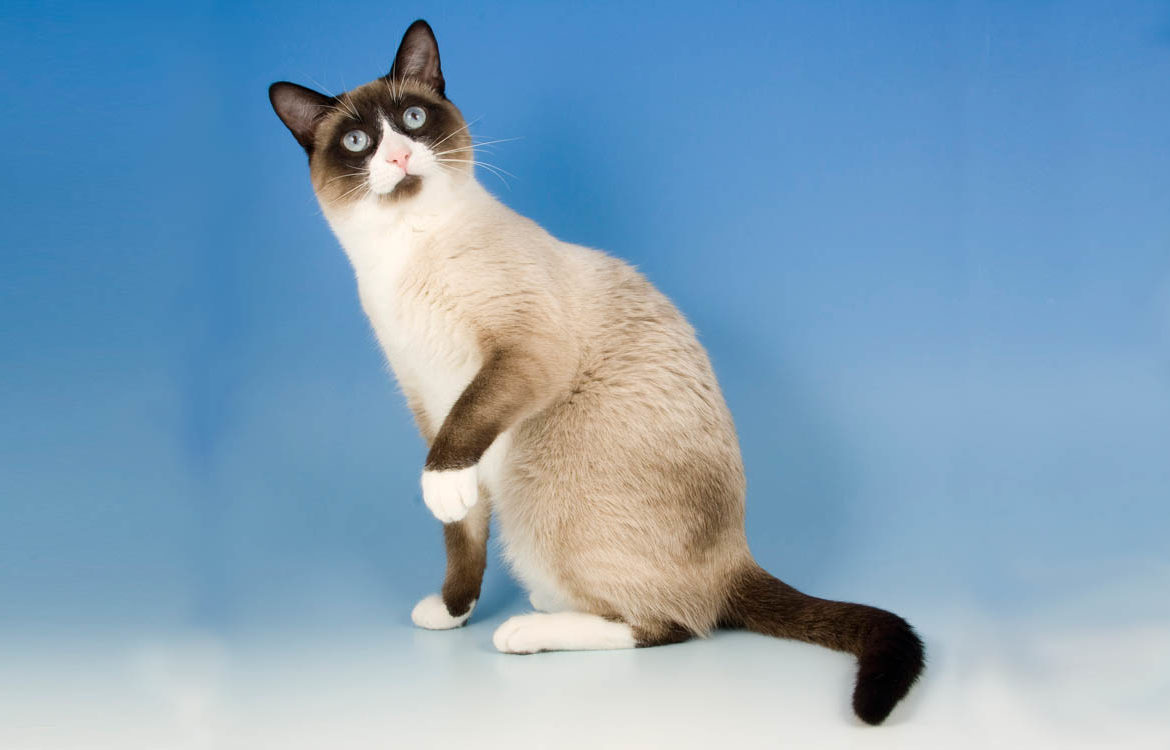
The Snowshoe is a medium-sized cat with a foreign type body, combining the heftiness of its shorthair ancestors with the length of its oriental ancestors. It has a long, firm body with medium bone and musculature, well-knit and powerful without bulk, and presents an impression of an elegant, athletic cat.
The head of the Snowshoe is a broad modified wedge with slightly rounded contours, of medium length and size in proportion to the body. The top of the head is slightly rounded, with a slightly flat forehead, and the nose is straight and of medium length. The eyes are blue, bright, sparkling, and expressive, walnut-shaped, with greater length than width, and slanted towards the base of the ears.
The coat of the Snowshoe is of medium-short to short length, bright and smooth with no noticeable undercoat. It should be considered a fault if the cat has a plush or double coat. The recognized coat color is a point coloration with a light body color and darker ears, face, legs, and tail. The points must be well-defined and in harmony with the body color, with sharply-contrasting white tips on the paws and nose/muzzle.
Temperament and Behavior
The Snowshoe is known for its affectionate, social, intelligent, and sweet-tempered nature. They enjoy the company of humans and being given attention, making them ideal for families. They usually attach themselves to one person and do whatever they can to get their attention.
Snowshoes are very social and docile, showing great devotion and love towards their owners. They dislike being left alone for long periods and can cope better with working hours if they have another cat companion. The cats are also noted for their intelligence, capable of learning to open various types of doors and being taught tricks, especially fetch.
They enjoy water, particularly running water, and may occasionally swim. This breed is generally compatible with children and other pets, making them a great addition to a family home.
Health Considerations
While the Snowshoe is generally a healthy breed, there are some health issues that owners should be aware of. A review of over 5,000 cases of urate urolithiasis found that the Snowshoe was over-represented, with three recorded cases out of a population of 16. This condition involves the formation of urate crystals in the urine, which can lead to painful blockages in the urinary tract.
Due to the breed's unique coat pattern, breeding can be challenging, and pet-quality Snowshoes may have too much white, too little white, or white features that are mismarked. This can be a result of the genes responsible for the white boots, which can be caused by a white spotting-gene or a gloving gene. The genes are difficult to control, and many cats' boots extend too far up the leg, do not reach far enough up the leg, or the cat completely lacks white.
Breed Standard and Recognition
The Snowshoe breed standard was first written by Vikki Olander, who also played a significant role in the breed's recognition and promotion. In 1974, the Snowshoe was granted "experimental breed" status by the CFF and ACA. By 1983, the breed had obtained champion status from the CFF, and in 1990, the American Cat Fanciers Association (ACFA) recognized the Snowshoe as a champion breed. The breed was also recognized by the International Cat Association (TICA) in 1993 and by FIFe in 2004.
Despite the breed's challenges, it has gained a strong following and is recognized by several major cat registries. However, breeders continue to face difficulties in meeting the requirements for acceptance by the CFA due to the limited number of cats and breeders available.
Popularity and Statistics
As of 2024, the Snowshoe ranked at position 44 out of 54 breeds in popularity according to FIFe, one of the major global cat registries. This translates to 0.04% of their total registered kittens, which amounts to 35 cats. The breed's relative rarity contributes to its unique appeal and charm.
The difficulty in breeding cats with the correct coat markings and patterns is a significant factor in the breed's rarity. Each Snowshoe has a pattern unique to the individual cat, relying on recessive genes and other factors to produce desired results. The genes responsible for the white boots and the "ᐱ" facial pattern are particularly challenging to control, leading to variations in pet-quality Snowshoes.
Buying a Snowshoe Cat
- Check for health clearances, including a review of over 5,000 cases of urate urolithiasis.
- Ensure the cat meets the breed standard for appearance, including the correct coat color and pattern.
- Look for a breeder who is involved in the breed's recognition and promotion, such as those associated with the CFF, ACA, ACFA, TICA, and FIFe.
- Consider the breed's rarity and the potential challenges in breeding and maintaining the correct coat markings.
While the Snowshoe is a relatively rare breed, its unique appearance, temperament, and intelligence make it a popular choice for cat lovers seeking a companion that is both beautiful and affectionate.
Frequently Asked Questions
What is the lifespan of the Snowshoe?
The average lifespan of the Snowshoe is about 14 - 19 years. Good nutrition and regular veterinary care support a healthy life.
What is the temperament of the Snowshoe?
The Snowshoe is known for: Affectionate, Social, Intelligent, Sweet-tempered. Its affection rating is very high. Its energy level is moderate.
What size and weight is the Snowshoe?
It is a small cat, typically around 3 - 5 kg as an adult.
Is the Snowshoe easy to care for?
Available ratings indicate moderate grooming needs, and moderate shedding. Routine brushing, ear and dental care, and nail trims are still recommended.
Is the Snowshoe good with kids and other pets?
Available ratings indicate high child-friendliness, and very high pet-friendliness. Supervised, gradual introductions are recommended.
How much exercise does the Snowshoe need?
With a moderate energy level, it needs walks, play or training matched to its stamina.



