Origin and History
The LaPerm cat breed originated in the United States in the early 1980s from a spontaneous mutation among farm cats. The breed founders, Linda and Richard Koehl, were on their farm in The Dalles, Oregon, when their cat Speedy gave birth to a curly-coated kitten named Curly, which became the foundation cat for all LaPerms.
After Curly's birth, a free-breeding colony of curly-coated cats developed on the Koehls' property. The breed was named after its distinctive curly coat, which resembles a shaggy perm. The name LaPerm is derived from the Chinookan tradition of adopting French words and incorporating the definite article to create a new word, following the pattern of 'la pipe' (pipe in French) becoming 'lapeep' in Chinook Wawa and 'la pomme' (apple in French) becoming 'lapom'.
The LaPerm Society of America (LPSA) was formed in 1997 to further the breed's advancement and became affiliated with the Cat Fanciers' Association (CFA) in 2000. The breed has since gained recognition in various registries worldwide, including the International Cat Association (TICA) and the Governing Council of the Cat Fancy (GCCF).
Physical Description
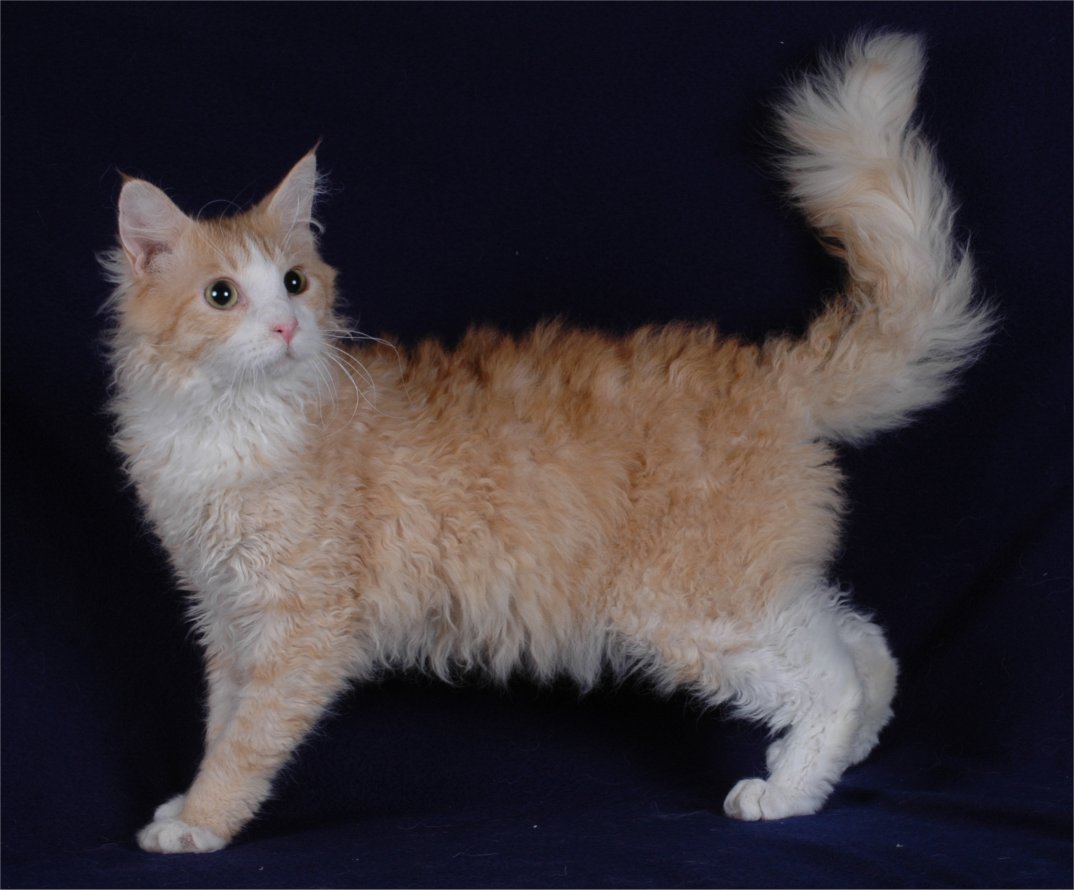
The LaPerm is a moderate breed with no extreme features, retaining its original type. It has an elegant and athletic build, with a medium-sized, muscular foreign-type body, relatively long legs, and a neck. The head is a modified wedge with rounded contours, a slightly broader muzzle than the wedge, and a straight nose profile with a break between the eyes leading to a slightly flat forehead. LaPerms have broad noses, flared ears, and medium to large almond-shaped eyes.
The coat of the LaPerm is its most distinctive feature, consisting of soft waves, curls, and ringlets, resembling a shaggy perm. The texture feels like mohair, with a slight "drag" to the touch. The coat is usually soft, with a textured feel rather than silky. It is loose and springy, standing away from the body, and lacks a thick undercoat. The coat length and fullness can vary with the season and the cat's maturity, but the longest and most defined curls are often found on the ruff and around the neck. Some LaPerms may have longer curly fur inside the ears, tufts at the ear tips, and longer, silky hair on the backs of the ears ("ear muffs"). Longhairs have a curly, plumed tail, while shorthairs have tails described as bottlebrush-like, and both have long, curled whiskers.
Like other rex breeds, all colors and patterns are acceptable in LaPerms, including tabbies, reds, tortoiseshell patterns, lilac, chocolate, and colorpoint. Recognized patterns include ticked tabby, shaded patterns, and pointed varieties, and the breed is also showable in the Karpati pattern.
Temperament and Personality
The LaPerm is known for its gentle and affectionate nature, as well as its high energy levels. They are very friendly and intelligent, making them easy to train and adaptable to various situations. LaPerms are often described as playful and quiet, making them suitable for a variety of households. They are also known to be hypoallergenic, meaning they provoke a significantly lower level of an allergic response in humans than normal cats, and they are often described as low-shedding.
LaPerms are social creatures and enjoy being around their human companions. They are likely to follow your lead, so if you're relaxing, they may decide to join you on the couch or in your lap. They are content to be lap cats and will often stay close to their owners, showing their affection and desire for attention.
LaPerms are also intelligent and can be trained to perform various tricks and commands. Their high energy levels make them suitable for active households, but they can also adapt to quieter environments, as long as they receive enough attention and exercise.
Breeding and Genetic Diversity
The LaPerm is a genetically unique breed, with a dominant gene causing their curly coats. They are not related to any other rex cat varieties. To maintain genetic diversity within the breed, breeding policies in various registries permit controlled outcrossing.
The International Cat Association (TICA) permits outcrossing to non-breed domestic longhair and shorthair cats. The Cat Fanciers' Association (CFA) allows domestic longhair and shorthair outcrosses, subject to its registration rules and timelines. The Governing Council of the Cat Fancy (GCCF) permits a small list of pedigree breeds as well as domestic longhair and shorthair cats for outcrossing.
When outcrossing to non-pedigree domestic cats, breeding guidance recommends selecting healthy cats of moderate type that closely match the desired LaPerm look and avoiding overly thick coats. This reflects the breed's origin in a population of non-pedigree cats and is described as a way to introduce fresh bloodlines ("hybrid vigor") into the gene pool.
In the UK, registration rules can affect how kittens from outcross matings are recorded and shown. The GCCF breeding policy notes that the full register is reserved for LaPerms with three preceding generations of LaPerm-to-LaPerm breeding. Cats with a domestic parent or grandparent are recorded on a reference register, and kittens become eligible for showing once the domestic cat is in the third generation (great-grandparent), with unknown ancestry pushed beyond the three-generation pedigree.
International Presence and Recognition
LaPerms have gained popularity worldwide and are present in many countries outside of the United States. The breed has been introduced to Canada, New Zealand, Australia, South Africa, Germany, South Africa, the Netherlands, Japan, England, and New Zealand. In Japan, the first LaPerm arrived in 1997-1998, and the breed has become established in several countries.
The LaPerm Cat Club exists in the UK and has contributed to the breed's progression through the GCCF recognition stages between 2004 and 2012. The breed is exhibited at GCCF cat shows, including the LaPerm Cat Club's annual show. The UK breeding program has focused on advancing generations from outcrosses by combining outcross, established, and imported lines.
In Germany, early imports included Ch Uluru BC Wiyaka, associated with Sabine Albrecht (Isanyati) and Sylvie Groenveld (Smeralda's). In the Netherlands, early imports went to Corine Judkins (Crearwy), and a breed club was established, with cattery prefixes that appear in pedigrees including Frank Stapel and Rina Stapel (Taricats), Karin Langeveld (Takoda), and Angela Bruynswyck (Brunswick's).
Health and Care
The LaPerm is generally a healthy breed, but like all cats, they can be prone to certain health issues.
LaPerms are known for their hypoallergenic coats and low-shedding properties, which can be beneficial for individuals with allergies.
Buying a LaPerm
- Research reputable breeders who have experience with the LaPerm breed.
- Consider the LaPerm's high energy levels and adaptability to various situations when choosing a home.
- Understand the breed's social needs and ensure you can provide adequate attention and interaction.
Buying a LaPerm requires careful consideration and research to ensure you find a healthy, well-bred cat that will fit into your lifestyle and household.
Frequently Asked Questions
What is the lifespan of the LaPerm?
The average lifespan of the LaPerm is about 10 - 15 years. Good nutrition and regular veterinary care support a healthy life.
What is the temperament of the LaPerm?
The LaPerm is known for: Affectionate, Friendly, Gentle, Intelligent, Playful, Quiet. Its affection rating is very high. Its energy level is high.
What size and weight is the LaPerm?
It is a small cat, typically around 3 - 5 kg as an adult.
Is the LaPerm easy to care for?
Available ratings indicate low grooming needs, and moderate shedding. Routine brushing, ear and dental care, and nail trims are still recommended.
Is the LaPerm good with kids and other pets?
Available ratings indicate high child-friendliness, and very high pet-friendliness. Supervised, gradual introductions are recommended.
How much exercise does the LaPerm need?
With a high energy level, it needs walks, play or training matched to its stamina.
Is the LaPerm hypoallergenic?
It has some hypoallergenic traits, but reactions vary. Spend time with one and seek professional advice before deciding.



