Origins and Development
The Burmese cat, a pedigreed breed of domestic cat, originated in Burma and is believed to have its roots near the Thai-Burma border. It was selectively bred in the United States and Britain, with most modern Burmese descending from one female cat, Wong Mau, brought to the United States in 1930.
The development of the Burmese breed was marked by a distinct difference between American and British standards. The Cat Fanciers' Association (CFA) formally recognized the breed in 1936, but suspended recognition a decade later due to extensive outcrossing with Siamese cats. The CFA lifted the suspension permanently in 1954, and the United Burmese Cat Fanciers (UBCF) compiled a US judging standard in 1958. In the UK, the breed was recognized by the United Kingdom's Governing Council of the Cat Fancy (GCCF) in 1952.
Historically, the European Burmese, also known as the "traditional" type, was declassed as a breed by the CFA in the 1980s to preserve "traditional" bloodlines, a move that led to the GCCF banning the registration of Burmese imported from the United States.
Breed Characteristics
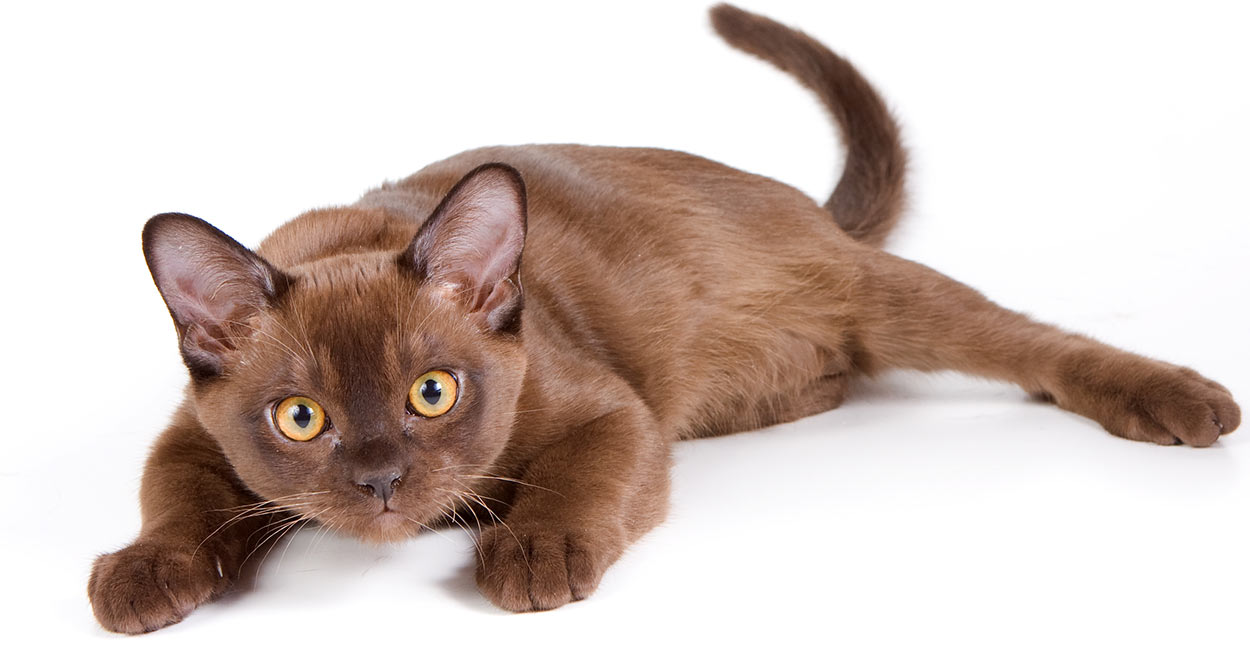
The Burmese is a small to medium-sized breed, weighing about 4-6 kg (9-13 lb). They are substantially-built, muscular cats with a rich dark brown coat, genetically referred to as black sepia. This coat, which is very short, fine, and glossy, is a characteristic of both the American and British Burmese standards.
Despite the differences in head and body shape between the American and British Burmese, both types have round eyes, a wide base for the ears, and a medium-length tail. The American type tends to be stockier, with a broader head, shorter, flattened muzzle, and rounded paws, while the British type has a more slender, long-bodied cat with a wedge-shaped head and long legs.
The Burmese breed is known for its high energy levels and playful temperament. They are curious, intelligent, gentle, and social, craving close physical contact and often following their humans from room to room. This breed also has a high adaptability and affection level, making them suitable companions for active and social households.
Health Considerations
Despite their robust appearance, Burmese cats are susceptible to certain health conditions. A study in England found a higher prevalence of diabetes mellitus in the breed, with 2.27% affected compared to the overall rate of 0.58%. Another study in the UK reported an average life expectancy of 14.42 years for Burmese cats, the highest in a study with a sample size of 45, and higher than the overall average of 11.74 years.
The breed is predisposed to feline orofacial pain syndrome (FOPS), a condition in young kittens where the eruption of the second teeth causes extreme discomfort. This condition requires pain relief intervention to prevent self-mutilation. The Burmese is also the most commonly affected breed for gangliosidosis 2, an autosomal recessive mutation of the HEXB gene.
Additionally, the breed is susceptible to hypokalaemia, a congenital form of the condition resulting from an autosomal recessive mutation of the WNK4 gene.
Genetics and Colour Variants
The Burmese colourpoint gene (cbcb), known as Burmese Colour Restriction or Sepia, is a temperature-sensitive acromelanism and causes a reduction in the amount of pigment produced, converting black into warm brown on the non-pointed parts of the coat. This gene can be combined with the Siamese/Himalayan-type "point" (cs) gene to produce the Tonkinese-type "mink" (cbcs) gene expression.
Originally, all Burmese cats were dark brown, but now they come in a wide variety of sepia colours. The first blue Burmese was born in 1955 in Britain, followed by red, cream, and tortoiseshell over the next decades. Chocolate first appeared in the United States in the 1970s, with lilac following in 1971. Currently, the British GCCF standard recognizes solid brown, chocolate, blue, lilac, red, and cream, as well as the tortoiseshell pattern on a base of brown, chocolate, blue, or lilac.
The American CFA standard recognizes the Burmese only in sable, blue, chocolate, and lilac. Other colours have been developed from these initial bases, such as cinnamon, fawn, caramel, and apricot, and their tortoiseshell variants, which have appeared in New Zealand.
Behavior and Interaction
Burmese cats are notably people-oriented and maintain their kitten-like energy and playfulness into adulthood. They are said to have several puppy-like characteristics, forming strong bonds with their owners and gravitating towards human activity. They often learn to play games like 'fetch' and 'tag', and enjoy human company.
These cats are persistently vocal, reminiscent of their Siamese ancestry, but their voices are softer and sweeter. They are not as independent as other breeds and are not suited to being left alone for extended periods of time. Their social needs are high, and they require regular interaction with their human companions.
Burmese cats have a dog-like attachment to their owners, which can cause greater dependence on human contact compared to other breeds. Their high level of interaction and vocalization makes them an engaging and entertaining companion for those who enjoy a cat with a lively personality.
Buying and Owning a Burmese Cat
When considering the purchase of a Burmese cat, potential owners should be aware of the breed's high energy levels and social needs. A Burmese cat requires a household that is active and able to provide ample interaction and attention. They are best suited for families with children or those who work from home or have flexible schedules that allow for regular companionship.
Owners should be prepared for the cost of healthcare and consider the potential long-term health management of the breed.
Before purchasing a Burmese cat, it is advisable to consult with reputable breeders and consider the breed's genetic diversity and potential health issues. It is also beneficial to research local rescue organizations that may have Burmese cats available for adoption.
Frequently Asked Questions
What is the lifespan of the Burmese?
The average lifespan of the Burmese is about 15 - 16 years. Good nutrition and regular veterinary care support a healthy life.
What is the temperament of the Burmese?
The Burmese is known for: Curious, Intelligent, Gentle, Social, Interactive, Playful, Lively. Its affection rating is very high. Its energy level is high.
What size and weight is the Burmese?
It is a small cat, typically around 3 - 5 kg as an adult.
Is the Burmese easy to care for?
Available ratings indicate low grooming needs, and moderate shedding. Routine brushing, ear and dental care, and nail trims are still recommended.
Is the Burmese good with kids and other pets?
Available ratings indicate high child-friendliness, and very high pet-friendliness. Supervised, gradual introductions are recommended.
How much exercise does the Burmese need?
With a high energy level, it needs walks, play or training matched to its stamina.
Is the Burmese hypoallergenic?
It has some hypoallergenic traits, but reactions vary. Spend time with one and seek professional advice before deciding.



